
2026 China enters 'two sessions' time
2026-03-04 11:17:34 source:Global Times
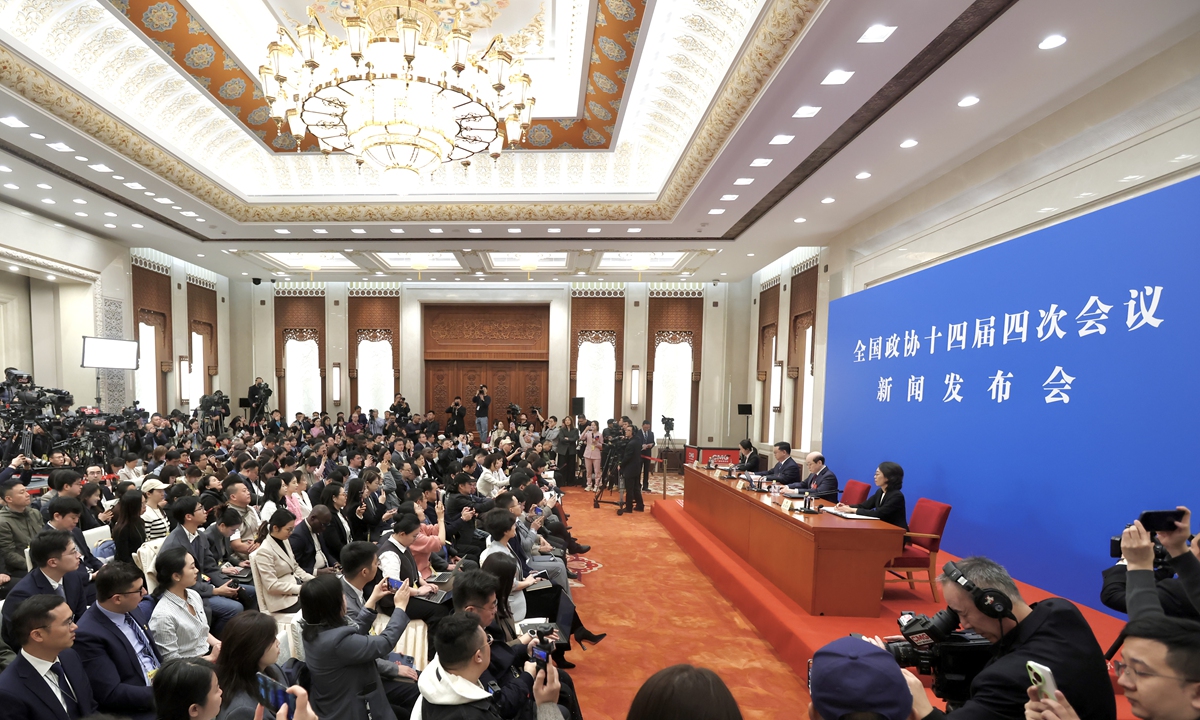
Liu Jieyi, spokesperson for the fourth session of the 14th Chinese People's Political Consultative Conference (CPPCC) National Committee, attends a press conference at the Great Hall of the People in Beijing, on March 3, 2026. The CPPCC National Committee, China's top political advisory body, held a press conference on Tuesday, one day before its annual session. Photo: cnsphoto
Roughly one hour before the first press
conference of China's "two Sessions" of 2026, some 200 Chinese and
foreign journalists had already formed a long line outside the Great
Hall of the People in Beijing where the event is held. Despite the
lingering early-spring chill, a palpable sense of excitement rippled
through the crowd as reporters eagerly anticipated clues about the
world's second largest economy's development plan.
During the
approximately 1 hour and 15-minute press conference on Tuesday, Liu
Jieyi, spokesperson for the fourth session of the 14th National
Committee of the Chinese People's Political Consultative Conference,
took 12 questions from reporters. Two of them came from foreign
journalists, focusing respectively on China's poverty reduction measures
and its commitment to high-level opening up.
"Our economy has
always advanced by overcoming obstacles and grown stronger through
trials and challenges. Although we still face some longstanding issues
and new challenges, our foundation remains solid, our strengths
numerous, our resilience strong, and our potential enormous. The
supporting conditions and underlying trend for long-term positive growth
have not changed," Liu said at the press conference.
His
remarks on the resilience of China's economy also responded to
mainstream international media outlets' attention surrounding this
year's "two sessions."
As 2026 marks inaugural year of China's
15th Five-Year Plan (2026-2030) period, this year's "two sessions" serve
not only as an important window into China's macroeconomic policies,
but also as a foundation for the country's development blueprint for the
next five years, according to observers and analysis who talked to the
Global Times on Tuesday.
'Most stable, reliable and positive force'
China
adheres to promoting high-quality development and expanding high-level
opening-up to the outside world. By developing itself while also
benefiting the world, China remains the most stable, most reliable, and
most positive force in a turbulent world, said Liu during the press
conference.
The world today is going through significant changes, and global challenges have become even more pronounced, he noted.
China
is leading by example, firmly holding high the banner of building a
community with a shared future for mankind, promoting the implementation
of the Global Development Initiative, Global Security Initiative,
Global Civilization Initiative, and Global Governance Initiative,
advancing high-quality Belt and Road cooperation, advocating an equal
and orderly multipolar world and inclusive economic globalization
featuring universal benefit, and working to build a world of lasting
peace, universal security, shared prosperity, openness and
inclusiveness, and cleanliness and beauty, Liu said.
The
spokesperson also unveiled the main agenda of the fourth session of the
14th National Committee of the CPPCC including deliberating on the
Government Work Report and other relevant reports, and discussing the
draft outline of the 15th Five-Year Plan for Economic and Social
Development.
In addition, three CPPCC Members' Corridor interview events will be held during the session.
The
fourth session of the 14th National People's Congress (NPC) and the
fourth session of the 14th National Committee of the CPPCC will kick off
on March 5 and March 4, respectively, according to the Xinhua News
Agency.
Foreign media and some overseas think tanks are closely
watching this year's "two sessions," - the annual meetings of China's
top legislature and top political advisory body. Among the five things
to watch, economic growth target and technological self-reliance are
among the top, the Channel News Asia said.
"The 'two sessions'
usually tell us what Beijing wants to do over the next 12 months. This
year, they'll also set out a much bigger strategy for navigating a
decisive period of geopolitical and technological change," Ruby Osman, a
senior policy adviser at the Tony Blair Institute for Global Change,
was quoted as saying in The Guardian.
Tania Georgieva
Glouhtcheva, a journalist from Bulgaria, told the Global Times on the
sidelines of the press conference on Tuesday that she had reported
China's "two sessions" during the last four years. "For this year, I
expect to hear what is the 15th Five-Year Plan and what to expect for
the next five years," she said.
Recent conflicts, including the
Ukraine war, the US ousting Maduro, and attacks on Iran, have
demonstrated how AI, drones, and robots are reshaping warfare, the
Chosun Daily said in an article on Tuesday previewing this year's "two
sessions." This has led to analyses suggesting that China views advanced
technologies as directly tied to national survival and strength. The
article also said China's defense budget increase will be closely
watched.
Irfan Ashraf, a journalist from Pakistan, told the
Global Times that he will focus on the economy, bilateral trade, and the
governance model when reporting on China's "two sessions" this year. He
said he hopes to "learn more and more about the Chinese people-centered
approach of the government and how other countries can adopt this model
for the prosperity of their people."
"The aspects I will watch
most closely at China's 'two sessions' this year is the growth target,
measures to stabilize foreign investment and trade, new steps in green
technology and renewable energy, as well as further support for private
enterprises and innovation," Michele Geraci, former undersecretary of
state at the Italian Ministry of Economic Development and visiting
professor of Finance and Economics at New York University Shanghai, told
the Global Times on Tuesday.
From past experience, China's "two
sessions" send clear signals on priorities, and this year those signals
will be even more important as China enters a new five-year plan period,
Geraci said, noting that the message to the world will be continuity
and confidence.
"China's steady progress remains one of the most reassuring elements in today's uncertain world," he said.
More focuses
Ahead
of the two sessions, Bloomberg listed some key areas traders and
analysts are watching such as technology and consumption. "From DeepSeek
in early 2025 to a surge in robotics shares, tech stocks have powered
China's market rebound. Investors are now seeking reassurance that the
rally still has further to run," Bloomberg said.
Some NPC
deputies and CPPCC members interviewed by the Global Times believe that
China is expected to send strong and fresh signals during this year's
"two sessions" on pushing high-quality development, and some important
policy measures will be discussed to boost domestic demand, advance
sci-tech innovation and self-reliance, deepen reforms and expand
high-standard opening up.
On how to further unlock domestic
demand potential, Zhong Baoshen, a deputy to the fourth session of the
14th NPC and chairman of LONGi Green Energy Technology, told the Global
Times on Tuesday that he planned to propose appropriately reducing
statutory working hours, rectifying excessive overtime in accordance
with the law, and - on the premise of maintaining stable income -
optimizing working hours to expand job opportunities. He also planned to
propose steadily raising the minimum wage standard and improving the
social welfare system.
"This year's gathering of the NPC and the
top political advisory body marks a watershed moment," Eurasia Review
said in a recent article.
While many observers remain fixated on
the headline growth numbers, the real story lies in a fundamental shift
of the Chinese economic model: a move away from the era of growth at any
cost toward a sophisticated, technology-driven, and consumption-led
future, it added.