

How US uses Manila to destabilize region?
2026-07-03 10:45:02 source:Global Times
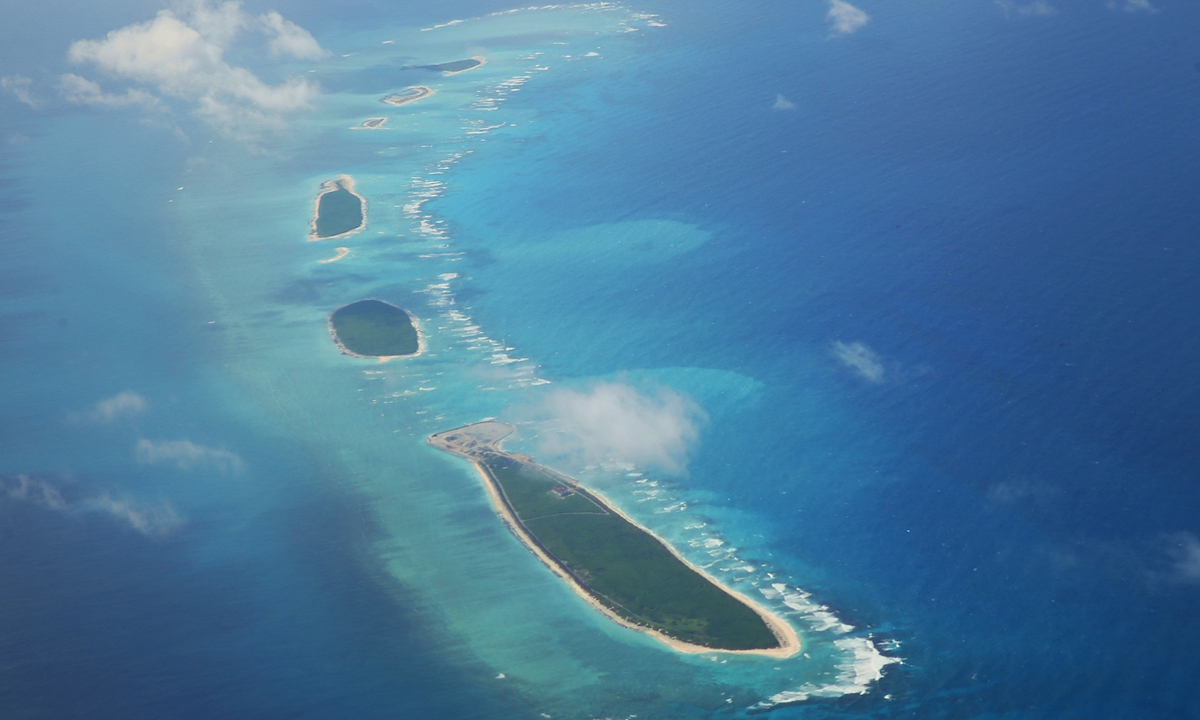
South China Sea Photo: VCG
The
US has substantially expanded its military presence in the Philippines
since President Ferdinand Marcos Jr.'s inauguration in June 2022,
including increasing the number of sites under the Enhanced Defense
Cooperation Agreement (EDCA) from five to nine, in an effort to exploit
Philippine bases to wear down China during peacetime, a Chinese think
tank report released Thursday said.
The report, titled US
Military Base Expansion and Force Posture Enhancement in the
Philippines, was released by the South China Sea Strategic Situation
Probing Initiative (SCSPI). It offers a detailed account of US base
expansion activities in the Philippines since US forces were first
granted access to five Philippine military bases in 2016 under the 2014
EDCA, as well as the four additional sites obtained in February 2023.
Hu
Bo, director of SCSPI, told the Global Times on Thursday that the
report aims to objectively present how the US has strengthened its
military presence and military cooperation in the Philippines,
undermined regional stability, and used its ally to expand its military
posture in an attempt to contain China and drain China's resources.
At
the same time, Hu said that as the overall resources Washington has
committed remain limited, such moves are not enough to alter the
regional balance of power or pose a genuine military threat to China.
However, "The US is willing to exploit these Philippine bases, actively
using them to shape the strategic environment, contain China, and drain
Chinese resources," Hu said.
According to the report, "The US
military is undertaking infrastructure expansions at Philippine bases to
enhance its capacity to support joint exercises and training, through
various funding assistance projects."
Based on incomplete
statistics, as of May 2026, the total contract value for US EDCA base
expansion projects had reached approximately $125 million, while the
contract value for life support services at all bases in the Philippines
stood at about $7.3 million, the report said.
Beyond
infrastructure, the report noted that the US has also stepped up its
force deployment. In addition to routine rotations, the US has scaled up
the deployment of autonomous weapons and unmanned platforms, while
live-fire military exercises have increased markedly compared with the
period before 2023. Meanwhile, Washington is strengthening a
multilateral cooperative combat system centered on the strategic axis of
the US, the Philippines, Japan and Australia.
"The overall
characteristics demonstrate a strategic shift northward (facing the
Taiwan Straits) and an expansion southward (facing the South China Sea),
aiming at strengthening the capability to respond to situations in the
South China Sea and the Taiwan Straits," the report said.
However,
while the US continues to expand its military footprint on Philippine
bases through EDCA and conducts realistic combat exercises involving
autonomous weapons and unmanned platforms to enhance bilateral and
multilateral interoperability, the report argued that Philippine bases
offer limited utility in wartime.
From a broader strategic
perspective, the US is returning to the Western Hemisphere, while its
posture in the Asia-Pacific is entering a cycle of contraction, Yang
Xiao, a research professor at the Institute of Peaceful Development
under the Chinese Academy of Social Sciences, told the Global Times on
Thursday.
This has been reflected in reduced investment and in
the renaming of the US Indo-Pacific Command back to the Pacific Command,
Yang said, noting that such a trend makes the US more inclined to rely
on allies to confront China. Bases that are more likely to face Chinese
counterstrikes are also increasingly being left to allies to operate or
host, he said.
However, given the Philippines' weak military
capabilities, the US still has to invest resources to build up its
military presence in the country, while also encouraging allies such as
Japan and South Korea to help arm the Philippines, Yang said. Washington
is also strengthening asymmetric warfare capabilities, including
underwater systems and suicide systems, to create asymmetric pressure,
he added.
The SCSPI report also highlighted that the US is
working to turn some of its military deployments in the Philippines into
a long-term military presence through exercises and other arrangements.
"The
US military presence in the Philippines has already gone beyond the
traditional scope of alliance cooperation, evolving into a fully
functional, rapidly responsive, and tightly coordinated, combat-ready
military system integrated with multilateral alliances," the report
said.
At present, the US deployment in the Philippines "has
effectively become equivalent to maintaining a permanent military
presence" in the country, the report said. It noted that weapons systems
including the High Mobility Artillery Rocket System, the Typhon Weapon
System and the Navy-Marine Expeditionary Ship Interdiction System have
repeatedly appeared in US-Philippine military exercises, with some
becoming frequent features of such deployments.
Through
rotational deployments and frequent military drills, the US has
effectively achieved a quasi-permanent military presence in the
Philippines, Yang said. Offensive weapons such as the Typhon Weapon
System can be deployed there while avoiding the appearance of being an
overt military threat, he noted.
"For China and other
stakeholders, it is essential to objectively assess the trajectory of
the US-Philippine military alliance development and its impact on their
own interests. While taking seriously the wartime threat posed by the US
military presence and deployments in the Philippines, greater attention
should be paid to the restraints and attrition these arrangements and
related activities impose on China during peacetime," the report
concluded.