

China-ASEAN School launched
2026-07-06 12:53:25 source:Global Times
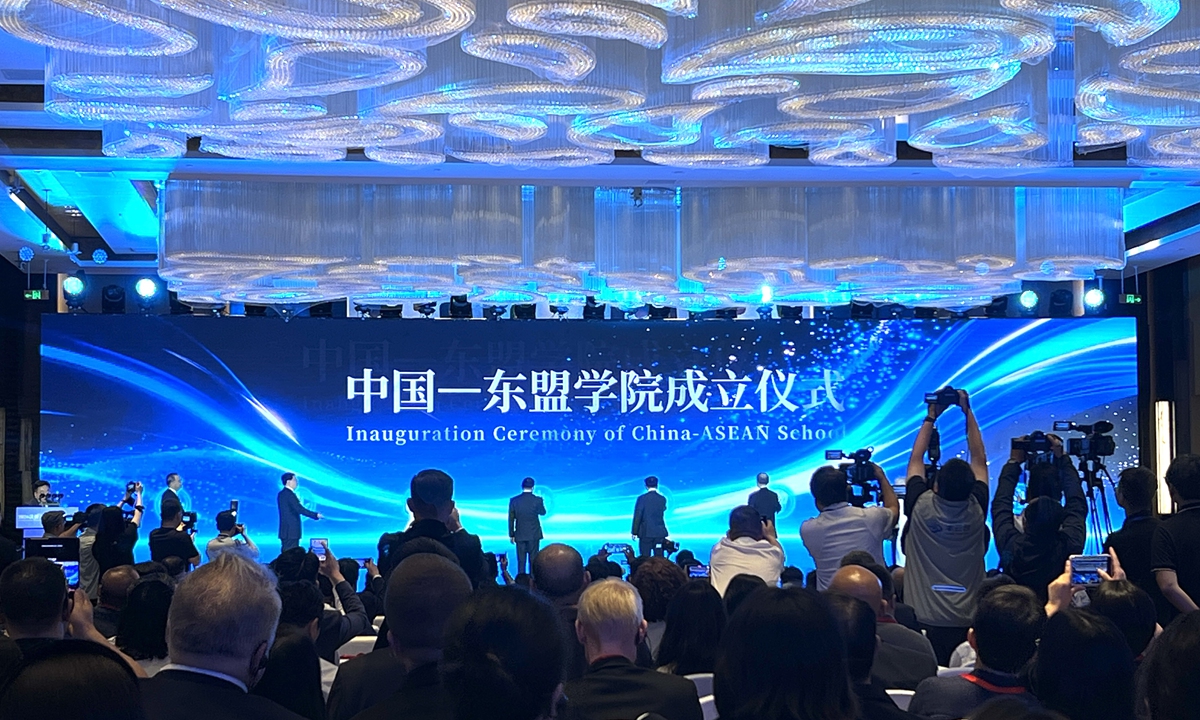
The China-ASEAN School is officially inaugurated in Beijing on July 5, 2026, aiming to build a long-term platform connecting legal scholars and practitioners from China and all ASEAN member states while promoting two-way exchanges in legal education, research and practice. Photo: Sun Langchen/GT
The 2026 Conference on Exchanges and Mutual Learning
of the Rule of Law of Civiliazations was held in Beijing on Sunday,
bringing together more than 150 legal scholars, judges and experts from
over 20 countries and regions to explore how legal dialogue can
strengthen mutual understanding among civilizations and address emerging
global challenges. Against the backdrop of accelerating technological
change and climate risks, governance of artificial intelligence and
ecological protection emerged as two of the most discussed issues
throughout the event.
The conference featured four parallel
forums focusing on the autonomy of Chinese law, legal protection for the
digital economy, cultivation of legal talent and global governance of
financial crimes. During the opening ceremony, the China-ASEAN School
was officially inaugurated, aiming to build a long-term platform
connecting legal scholars and practitioners from China and all ASEAN
member states while promoting two-way exchanges in legal education,
research and practice.
Addressing the opening ceremony, Kao Kim
Hourn, Secretary General of ASEAN, stressed that no legal tradition has
evolved in isolation and that mutual learning has always driven the
development of legal civilizations. Describing China as a close partner
in ASEAN judicial cooperation, he said legal diversity should be
regarded as a source of strength instead of a barrier, adding that
deeper China-ASEAN legal cooperation will be essential as countries
confront increasingly complex cross-border challenges together.
That
emphasis on dialogue over uniformity resonated throughout the
conference. Miguel de Serpa Soares, former under-secretary general for
Legal Affairs and United Nations Legal Counsel, said in his speech that
cross-border cooperation depends on understanding each other's legal
systems, and legal diversity should be viewed not as an obstacle but as
the very condition in which international law operates. Citing the
Chinese philosophy of "harmony without uniformity," he added that
lasting international order ultimately depends on legitimacy built
through consistency, reciprocity and inclusiveness rather than power
alone.
While many Western legal systems developed environmental
law primarily through pollution-control legislation and administrative
regulation, China's approach has increasingly integrated ecological
considerations into constitutional governance and judicial
decision-making, Antonio Herman Benjamin, President and Chief justice of
Brazil's National High Court , said after being appointed an honorary
professor of China University of Political Science and Law.
Benjamin
pointed to China's network of nearly 3,000 environmental and ecological
adjudicatory bodies, as well as its public interest litigation system,
which enables courts to protect ecological interests even when no direct
victim can be identified.
Responding to a Global Times question
on the recent debate in parts of Europe, where record-breaking heat
waves have reignited discussions over air-conditioner use, energy
consumption and the balance between climate protection and human
well-being, Benjamin said the debate should not lose sight of the root
cause.
"At the end of the day, the problem is not air
conditioners. The problem is climate change," Benjamin told the Global
Times. He argued that governments should both protect people during
extreme weather and address the root causes of climate change by
reducing carbon emissions, where China is making good progress, warning
that "otherwise, we'll end up with a planet of air conditioners."
Looking
beyond environmental governance, Benjamin said China and Brazil have
expanded cooperation from trade into law, science and technology. He
praised China's rise in the electric vehicle industry, attributing it to
technological innovation and effective public policy, and said
environmental law will remain one of the most promising areas for
bilateral cooperation because the two countries increasingly "speak the
same legal vocabulary" on issues such as climate change and
biodiversity.
The same emphasis on balancing development with
governance also shaped discussions on artificial intelligence, another
issue that drew widespread attention during the conference. The topic
gained additional public attention on Sunday after news that Doubao, a
popular Chinese AI app, would take its AI agent function offline on July
15, with some users welcoming the move over privacy and ethical
concerns, while others expressed reluctance to lose AI agents created in
the likeness of deceased relatives or public figures.
Against
this backdrop, Zhang Linghan, dean of the Institute of AI Law of China
University of Political Science and Law, said different jurisdictions
have adopted distinct governance philosophies. While the European Union
generally favors a stricter regulatory approach and the US places
greater emphasis on industry-driven innovation, China's approach seeks
to balance security and development while contributing practical
governance solutions to the international community.
She cited
China's early adoption of mandatory labeling requirements for
AI-generated content and regulations governing anthropomorphic AI
interaction services as examples that have attracted growing
international attention.
"While technology evolves rapidly and
legislation inevitably lags behind, the law's protection of personality
rights and personal information remains constant, Zhang told the Global
Times.
As ASEAN has become the first destination for many Chinese
AI companies expanding overseas, Zhang said that deeper legal dialogue
and regulatory cooperation will be increasingly important to facilitate
technological collaboration and cross-border innovation.